
Our Shaped by Dog podcast is designed to be heard or viewed. If you are able, we encourage you to listen to the audio or watch the video, as each includes nuances of emotion and emphasis that might not come through on the written word. Transcripts are generated from the audio, then humans review with love and care, and then there's a double check by our dogs. If you are quoting in print, please check the audio first for full context. Thank you!
Speaker Key
SG Susan Garrett
Transcript
00:00:00
The behavior starts to amplify, it starts to intensify, until you get to a point where your puppy is all out
screaming at you “I want that licky mat, now!”
00:00:18
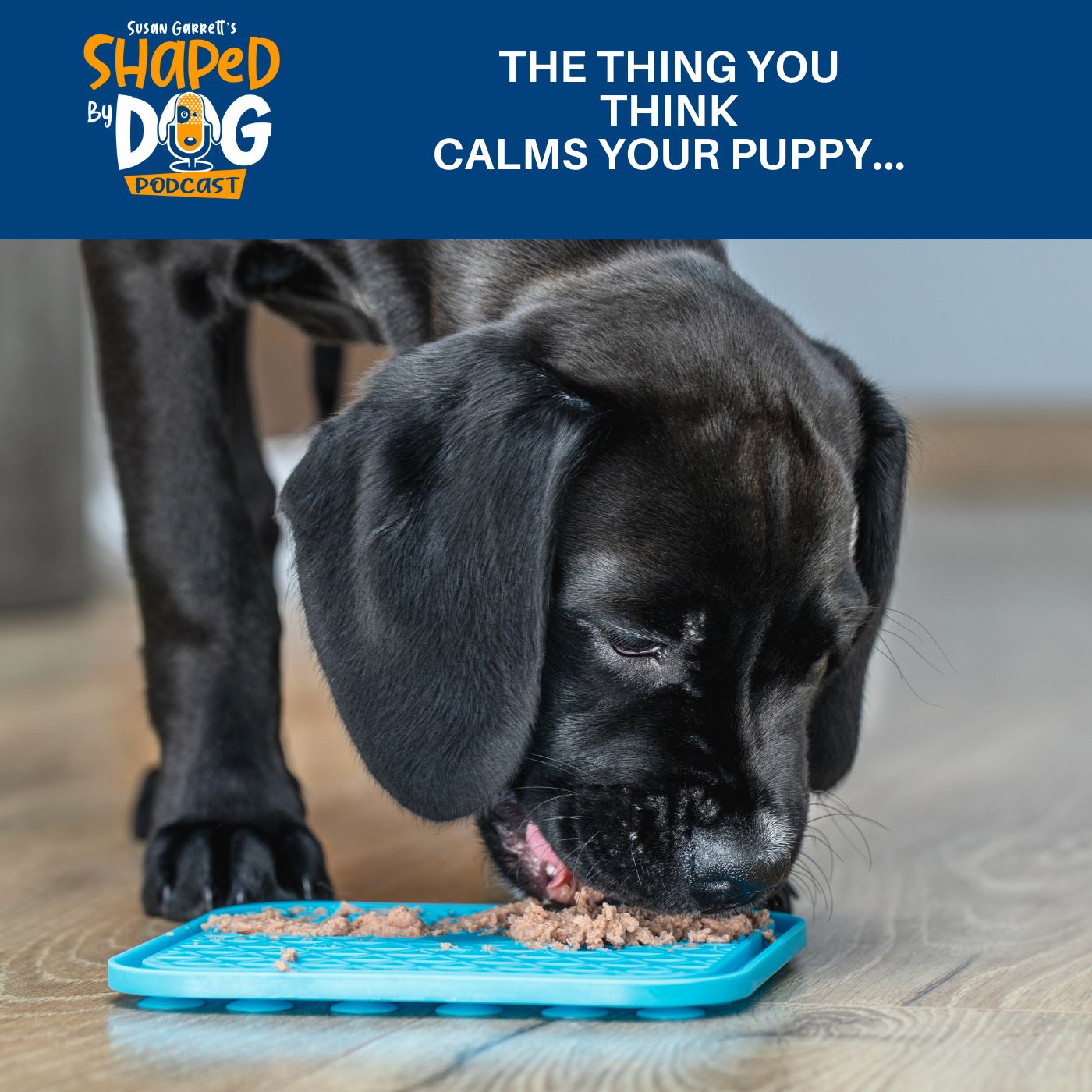
Hi, I am Susan Garrett. Welcome to Shaped by Dog. Have you ever grabbed a lick mat to help calm
your whiny puppy? And within minutes of giving the lick mat, you're like, “Oh, peace, success.” But the
question is, is that success, that peace coming at an expense to you?
This episode has been inspired by me visiting with a friend whose Doodle was anxious in her ex-pen.
And my friend said, “Oh yes, she does get pretty restless at this time of day, and I'll just get her a lick
mat.” And she gave her a lick mat. And yeah, she licked it. She's perfect.”
00:00:55
Now, if you're a regular listener to the Shaped by Dog podcast, you would then be familiar with podcast
episode number 16, ‘the thing before the thing.’ Here's how a lot of puppies appear to be anxious.
Number one, truly, some puppies can be anxious. It could be fear. It could be that they're just under
stimulated.
It could be that they're not living an enriched life. You can refer to Shaped by Dog episode number 314
and 315, where I talked about the nirvana of enrichment for everybody's puppy or adult dog. But let's
backpedal a little bit because here's where a lot of this starts.
00:01:36
Have you ever noticed that when you're feeding your dog, or your dogs if you have more than one, that
they get a little bit happy behind you? Maybe they are circling. Maybe they're wagging their tail. Maybe
they're whining. Maybe they're vocalizing a little bit more than that.
Maybe they're saying like, “Hurry up, hurry up, hurry up. It's dinner time. I want my dinner. I want my
dinner. I want my dinner.” Now, if you have a dog that doesn't care about their dinner, this is probably
not going to be a problem. However, if you are a person that maybe you're preparing your lick mat for
your puppy, and what is your puppy doing?
00:02:11
They might be in the kitchen, and you might be in a back counter somewhere and you're preparing it,
and what is the puppy doing? Are they circling in the ex-pen? Are they whining? Are they barking at
you? Are they pawing? Are they bouncing? I had a Terrier that that's exactly what she would do as you
prepared food. She would whine. She would pounce off of your butt and sometimes she would just
jump and pop up beside you. The thing before the thing tells you that all of that leads to the ultimate
reinforcement of the dog getting their food.
So, we are preparing a lick mat in the hopes of creating calm. And what ends up happening is it builds,
so maybe you don't even notice it at first, you're preparing a lick mat because you want to give it to
your puppy because you want to maybe do some reading and you want your puppy just to chill for a
little bit.
00:03:05
And so, after two or three lick mats, she learns, when she goes back there and I hear the tinkering of
the bowl, I get my lick mat. So that's when the first little “Aaahh” singing the songs of my people
happens. “I'm just enhancing the experience for you while you're out there making me a licky mat.”
You might not even notice the first thing that happens because that first thing might be a circling or a
pawing. “Can I get closer to you so I can help you?” But I promise you there is some expression of the
emotion the puppy is feeling. “You are making me something I want, I want it faster.”
00:03:45
And when you deliver that lick mat, the thing before the thing, the behavior starts to amplify, it starts to
intensify. Until you get to a point, you may already be there where your puppy is all out screaming at
you. “I want that licky mat now. I am really excited about this.”
So somewhere between the first circles and the all-out screaming obscenities at you, there is a
gradient of behavior that makes that puppy appear that this is the time of day they're more anxious. So,
what can we do about it if we are there?
00:04:25
Number one is stimulate that dog's brain. Do some training, get them out for a walk. Now, my puppies,
once they are, I don't know, three or four months old, they go for off leash walks with me, not with my
pack of dogs, just myself, off leash walks, so they get to practice coming to me when I call them, they
get to sniff, they get to go get some physical exercise, not on a leash, just off leash.
Now, I know that's not maybe possible for everybody, but there are ways you can find like sniff spots
that you can rent for 20 minutes. But this podcast episode isn't about exercise. I'm just saying these are
some of the things that help lead to a puppy that isn't showing anxiety that you believe that they need
now have their lick mat.
00:05:13
But what are we going to do when we know we would like to use a lick mat, but we have an anxious
puppy. So, here's what I would advise you to do. If you have somebody else in the house that can take
that puppy out and play with them outside or go for a walk, anytime you're going to make a lick mat,
that's what I would do first. If that's not a possibility, then this is what we're going to do.
If you’re the kind of dog owner who truly wants to understand, not just manage your dog, then
subscribe to the channel. We're going to get multiple lick mats. Maybe 3, 4, 5 lick mats and you're
going to prepare them all and put them in the freezer, and you are going to then go back and sit down.
Maybe you're going to take your puppy out, maybe not.
00:05:52
But when your puppy is relaxed and they've forgotten about the fact that you prepared a lick mat, that's
the time that you're going to go get one for them. You're going to now have a new trigger. You going to
the freezer and opening the freezer eventually will become the trigger. So maybe you're going to have
to go to your freezer several times a day and walk by the puppy without having a lick mat in your hand.
Because what we want is to associate calm puppy, lick mat comes out. Now, I use lick mats, or you
might be using a stuffed Kong for the same thing. I use them very strategically. So, there's different
ways I use them and there's different stages of each way. I want to share that with you.
00:06:35
First of all, let's say we have a dog who has an issue. “I'm afraid of tall men.” or “I'm a puppy who is
suddenly in a fear period. And I get worried when anybody comes through the door.” So, what's going
to happen is they might alarm bark. An alarm bark from a puppy is very distinct. And if you run and give
them a lick mat then, you are pacifying. You are trying to curb their anxiety.
Now, that puppy may or may not lick the mat once they're in that fight or flight mode. Don't think you
are then reinforcing the puppy. Put the lick mat down anyway. But the best thing to do is to know people
are coming.
00:07:16
So, if you have a puppy that has shown you once ‘I am going to alarm bark because I'm a little worried
about the people’, then what you're going to do, you're going to give them that lick mat anyway. And
see, will they take it? Like I said, if they're really afraid, they may not. For sure don't let the people near
the puppy. Have the people talk, casually sit down and talking with you.
So, what we want to do is know people are coming at 10 o'clock, so at 9:58 I will be getting my lick mat.
I would like to pacify my puppy. So that the puppy is engrossed in the lick mat before the people come
through the door. They may still give a “woo-woo” and that's okay. They're going back to the lick mat
ideally.
00:08:01
If they're not, then we're going to start with the puppy further away from the door. In this stage, stage
one, this is, a lick mat is pacifying, is entertaining, is distracting. It's not really doing much except
helping to get the puppy's mind off of what is potentially what we see as an inert fear. But in that little
puppy brain is a real fear.
So that's stage one. Pacify, entertain, distract. Now, if that puppy gets to a point where they might just
go, “woo”, they don't really respond when somebody comes through the door anymore. The pacify,
entertain, and distract mode has been working.
00:08:41
It might take a week, it might take two weeks, it might take a month, it might take two months. Now,
you're going to move into conditioning. We really want to build some conditioning for that puppy. What
we're going to do is the moment the doorknob starts engaging, like somebody's coming through the
door, or the moment somebody knocks, the lick mat goes down.
The thought somebody's coming in means you get something amazing. You're going to work at that
stage of conditioning. So, the puppy then looks forward to somebody coming. They might start wagging
their tail instead of barking. Now, you know, you can move to the third stage where we're going to
reinforce, and that reinforce might look something like this.
00:09:24
You might have moved on beyond the lick mat. You might just, somebody comes in the door, the puppy
starts wagging their tail, you say, “good baby,” and you throw a handful of cookies in the pen for them to
search.
You might then eventually get to the place where the puppy's loose and you're throwing it on the
ground. And you'll probably get to a place where the puppy has been conditioned to love the sight of
people.
00:09:45
So now you can stop reinforcing that because the people themselves is very reinforcing to the dog, and
you're probably going to have to start reinforcing ‘go to your bed when the people are here, so you
don't go too crazy on them.’ So that's a way that you can use a great, great tool in a way that creates
great, great behavior.
I just want you to be aware that the whiny barky puppy might be there because of the inadvertent
reinforcement that you've been giving them when their needs weren't met fast enough by you preparing
their food or preparing their lick mat or preparing their Kong.
00:10:23
They're great tools, but the idea of using these tools is they shouldn't be a just a crutch for you to
manage the dog for the rest of their life. There should be a strategy behind every time you pull out a
lick mat, every time you use a Kong, it is an intentional use of building better behavior. I'll see you next
time right here on Shaped by Dog.