
Our Shaped by Dog podcast is designed to be heard or viewed. If you are able, we encourage you to listen to the audio or watch the video, as each includes nuances of emotion and emphasis that might not come through on the written word. Transcripts are generated from the audio, then humans review with love and care, and then there's a double check by our dogs. If you are quoting in print, please check the audio first for full context. Thank you!
Speaker Key
SG Susan Garrett
Transcript
00:00:00
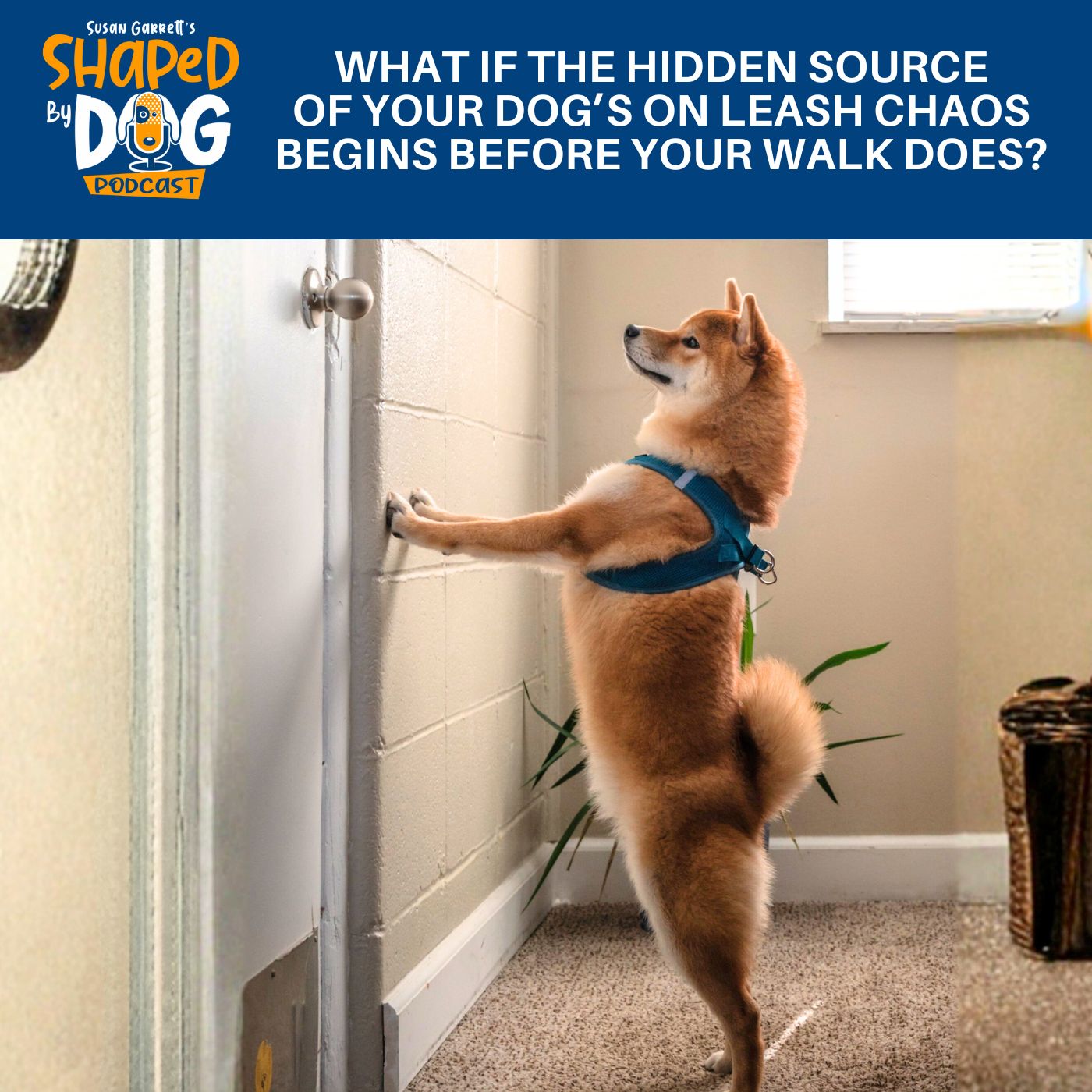
Have you ever seen a dog that when their owner wants to take them for a car ride or out for a walk, or
maybe they're entering an agility trial and the dog's going ballistic, jumping, whining, barking, maybe
nipping, pulling, like having an emotional meltdown because they're so excited for what's about to
happen.
Have you ever saw that and wondered “what's going on and how did we get to this point?” Well, to
quote a line from All The President's Men, yes, I'm that old that I remember that movie, the line is
“Follow the money.”
00:00:46
Hi, I'm Susan Garrett. Welcome to Shaped by Dog. And ‘follow the money’ is a great phrase for you to
remember in all dog training. It doesn't matter what the problem is that you are seeing. Follow the
money. The money is the reinforcement the dog is getting for doing the thing that you don't want them
to do.
There is reinforcement happening; I promise you it's there. I'm going to out somebody that was training
here this week, she let her dog in the building and the dog instantly ran to go up one of the obstacles in
A-frame and she said, “No, don't go over there. Don't go over there. Don't go over there.”
00:01:19
And then as she was getting ready, the dog went on the dog walk and she said, “Oh, it's too late, he’s
on the dog walk.” So, then she said the word “target” to tell the dog to come into position. Follow the
money. Why does your dog constantly try to get on contact equipment?
There is some reinforcement. And even if you didn't give them a cookie for coming into position, you
told them to go into position, which is reinforcing. So, let's get back to our dogs’ spinning, barking,
whatever they're doing fest, when you want to go out for a walk or you want to go for a car ride. Follow
the money.
00:01:53
Why are you seeing that? Because they are anticipating something amazing is about to happen. And if
you're like many of us, you might have even added a trigger to that. So, Barbara Woodhouse said
“Walkies!” So, the dogs learn that ‘we're going for a walk.’ I am a little bit more, simple when I just say,
“Who wants to go for a walk?” “Who wants to” are three words that pique my dog's interest.
Ears up, eyes bright, but no, there's no barking. No there's no spinning. So, you can have a dog that's
engaged and anticipating something amazing and they don't need to be barking or spinning.
00:02:27
So, if you are like me and you don't like the anarchy that that can cause, and really my main reason for
doing it is my first dogs were Terriers. So, you get three intact female Terriers spinning and barking, and
somebody bumps into somebody and then somebody's calling somebody's mother, you know, a bad
name. All hell could break loose, and it never did because of what I'm going to share with you today.
00:02:50
Follow the money. Where's the reinforcement for what you want? So, a dog that knows, they see you
pick up the leash. And as I spoke about in Shaped by Dog episode number 16, the thing before the
thing, I know when I see that thing that this thing is going to happen.
So, the trigger is you pick up the leash and that triggers barking, hysteria, craziness. And hey, by the
way, if you do have all of that chaos, the problem may be more than just what's happening at your front
door. So, I suggest you jump over to YouTube and you check out the playlist I have on Creating Calm.
00:03:28
And while you're there, be sure to like this video, leave a comment and subscribe to the channel. That
way not only will you not miss all of the amazing free dog training videos that we have for you over
there. But YouTube is going to share our videos with other dog loving people like you that get unique
reinforcement-based dog training strategies that really are hard to find anywhere else.
So the first thing we're going to do is counter condition any triggers that cause that. It could be you get
multiple leashes and put them around the house and what is it we want to see? We want to see
calmness.
00:04:03
Now you could say, “When I pick up a leash, I want you to go in a dog bed near the door while I get my
boots on.” It could be that “when I pick up a leash, I want you just to chill.” So, you can just pick up a
leash like it was a clicker and throw cookies at your dog.
If picking up the leash is way too much, touching a leash and throwing—. So, something that doesn't
look like ‘we're about to go for a walk’, just move the leash around on the table and then throw your dog
a cookie
00:04:28
So, we are going to create a new positive conditioned emotional response for the dog at you touching
the leash. And eventually you could walk around the house with a leash. You could do anything you
want. And you can reinforce the dog for not—, they can be alert, eventually they're not going to be as
alert because they're going to realize you're not going for a walk every minute of the day.
So, we need to create a calm beginning. We need to create new money for new behaviors. Because
the big money came because ‘You picked up a leash, I started whining.’ ‘You put on your coat, I start
circling.’ ‘You put your hand on the door, now I start running up the door barking, maybe nipping, going
cray, cray.’
00:05:08
‘And then you open the door. I fly out that door and I pull you down the stairs.’, like you see in a lot of
those Instagram reels that I admit I'm a bad person and I probably laugh at them. So, the ultimate
money is the opportunity to pull you down the stairs and start that adventure. Now, if that's the way you
start your walk, is it any wonder that when your dog sees a distraction, you have zero chance?
There is no cookie in the world that will get your dog’s focus back on you. So, we need to change the
hysteria, create a more productive trigger for all of these behaviors in your current chain and reallocate
the money. Because every dog behavior that you love comes from money being distributed
appropriately and the behaviors you don't like, that's dirty money, that's got to go.
00:05:56
So, we're going to start by creating the new behavior of ‘picking up a leash doesn't mean you lose your
mind.’ Next thing we're going to do is we're going to take a simple game that is a foundation of
everything I do, the Collar Grab. And we're going to turn it into a connected collar grab.
So, you're going to grab your dog's collar because that's what you have to do before you put on the
leash. And you're going to get the dog to look up at your face and then you're going to feed them. So,
collar grab means you're not going to say anything, you just collar grab and feed the dog. Collar grab
and feed the dog.
00:06:24
Eventually they're going to be looking towards you. Now there's more sophistication to that, but that will
get you where you need to go for now. Now we've created a connected collar grab. So, connection is
beginning. We put on the leash, and we can reinforce that, and then we can take it off and start all over
again.
We're going to do this in different locations at every different door until we can pick up a leash, clip it
on, and not have hysteria, but rather have connection. When you get to that point, you can add a word.
I use the word “connect”, which gets my dog to check in with me. I don't like people say, “Watch me,
heads up.” That always has an element of there are no options, ‘you do it or you die.’ ‘Do it, damn it.’
00:07:08
This is check in with me, “connect.” And if you do it right, they're going to want to do it and they're going
to do it reliably. Why this will fail is if you get a few little successes at home and then you go to the
bunny farm and you say, “connect”, and your dog doesn't check in, and you go “connect! connect! I
said connect!”
No, that's not what we're doing here. That's not what we're ever doing here. So, we have positive CER
for touching and picking up the leash. We have a connected collar grab. We have a connected
connection of the leash to the collar. Now we want to grow to, having a connected exit. So, there is no
potential of you being pulled down the stairs.
00:07:44
This has to start within your house. Ideally, you have at least one door, and the more doors the better.
That you can open a door, walk as you're walking through, just stop and pause. Your dog will turn
around and look at you go crazy, food rewards. Go back out and do it again.
Do it 15 times and then put your dog away and we're going to do it at another threshold. We want the
dog to know as you allow them to go through a door that they're going to look back at you. And you're
going to say, “Easy-peasy lemon squeezy in the house, Susan.”
00:08:17
But as soon as I open even the back door to go to the backyard, that's a different story. I got you.
Because what you're describing is a connected exit with a distraction value of 10 out of 10. Or maybe a
hundred out 10. And what I'm describing here in the house is a connected exit with a distraction value
of zero. But somewhere between zero and 10 are a lot of numbers.
We can start creating connected exits of varying distraction level. So, it might be something as simple
as putting a toy down on the other side of the door. Open the door, the dog sees the toy. Make it a
lower, very unappetizing toy, so the dog might glance at it and then look back at you.
00:09:04
Maybe get a remote car that when they glance at it, you can make it move a bit and then they glance
back at you. Then you could start driving that remote car. If you don't have that, no big deal. Just put
things that are more distracting to that dog. Put a bowl down. An empty bowl at first. And you're still
wanting that same connection. ‘I open the door, you go through, you spin around, you look at me. I
reward that.’
You can say “connect” because you've built that cue in, but I'd rather you don't. I want it to be the dog's
choice. If you put something that's super high value down like a bowl, drop a cookie in it, and then if
they're waiting too long, try ‘connect.’
00:09:41
If it doesn't work, do not repeat the cue because you're teaching them to ignore it. We don't escalate
the volume. We don't escalate the intensity. We take the feedback the dog's giving us, ‘This is too big a
distraction for me to connect in front of.’ How do we expect them to connect in front of the bunny farm
when we can't get them to connect in front of the bowl?
We're creating a connected dog here people, there's layers to that. This is especially true if the dog's
connection has always been to everything out there. So, if you have a dog, like Waffles, our American
Bully, American Bulldog, German Shepherd, Husky Mix, he would, go out a door and scan. What was
he scanning for? Other dogs, people, squirrels, whatever.
00:10:32
He's an adolescent boy who is looking for ‘who's in my area here?’ I'm okay with my dog looking, look
and then connect. I'm not okay with them staring and continuing to ‘Uh?’ Because what would happen if
there was something excited out there? Would the ability to connect happen? No. It's a fun game.
Before you sit down for television tonight, work through this strategy and then just play with it at
different times when you're home, before you go to work, when you get home from work, before you sit
down for television, before you go to bed, create moments of connection.
00:11:08
Do you think these moments of connection are going to hurt your relationship with your dog? Yeah, I
didn't think so either. So why not? Moments of connection, create a new money trail for the dog so that
the immediate response going out a door isn't to pull you down the stairs. The immediate response to
you preparing to go for a walk isn't hysteria and maybe a bite in the butt.
Okay, so now we've created these moments of connection. We've escalated up as high as we can.
You've done your absolute best to create really exciting distractions on the other side of the door, which
by the way, you can go through the door three or four times, connect, go through the door, and then
walk up to that distraction and tell them they can have it.
00:11:52
It is something that you would genuinely want them to have like a cookie in a bowl or a toy that they
love, but you really want to work this up to a person is on the other side of that door, to another dog
might be on the other side of that door.
What are the moments of connection that are important to you? And let's build a new money trail that
leads them all back to you. Now, we've built up our moments of connection. We're taking our show on
the road.
00:12:15
And what you're going to do is you're going to create a S.O.P. that we call it here in the business world,
a standard operating procedure for you going for a walk. “Oh, Susan, this sounds so detailed.” It's
going to make your life easier. Before you touch a leash, before you start any moment of connection,
you are going to say, what do I need for this walk?
Is it raining? Do I need my boots? Do I need my phone? I always take my phone because you know
what, I was taken out once going down a hill and laid in a heap with a torn-up knee. The phone came in
handy that day. I always take my phone. Plus, every once in a while, I get inspired to have a live with all
of you. So, what is it that's on your list of things that I'm going to take, knowing the weather, knowing do
you wear a bait pouch? Do you put cookies in your pocket? Do you have poop bags?
00:13:00
All of that should happen before you touch a leash. But that's not the way it is now because you don't
have a good dog walking S.O.P. So, now, we're going to change all that. Maybe it's all strategically in
one location. Maybe you get up first thing in the morning, and you put all the things you want in that
location, half hour, an hour before your walk.
Now you can get up and put on your boots, your coat, your scarf, your balaclava, all the things you
need to go for a walk in the Canadian winter and then start your connection process. Yeah, you may be
a little bit roly poly with all that gear, but that's okay. Process stays the same. You rehearse your new
money trail, you walk out the door as a connected team, and only good can come from that.
00:13:42
Now, this doesn't mean that you are going to have no struggles when you walk your dog, but there's
more strategies that we can add to the connected exit. But ask yourself this question, if playing all
these games that Susan just suggested creates a better relationship, more connection, and a
connected exit, is that going to be better or worse than what I've got right now?
And if the answer to that question is anything other than 100% it will be better, then jump over to
YouTube, leave me a comment and let me know why you think it would be anything less than better.
00:14:17
And if the answer is better, then let's get to work. Play some of these connected games, then jump
back to YouTube. Leave me a comment, let me know how it's going. And if you'd like more steps in the
connected walk process, I can share some of that in an upcoming episode. I'll see you next time right
here on Shaped by Dog.