
Our Shaped by Dog podcast is designed to be heard or viewed. If you are able, we encourage you to listen to the audio or watch the video, as each includes nuances of emotion and emphasis that might not come through on the written word. Transcripts are generated from the audio, then humans review with love and care, and then there's a double check by our dogs. If you are quoting in print, please check the audio first for full context. Thank you!
Speaker Key
SG Susan Garrett
Transcript
00:00:00
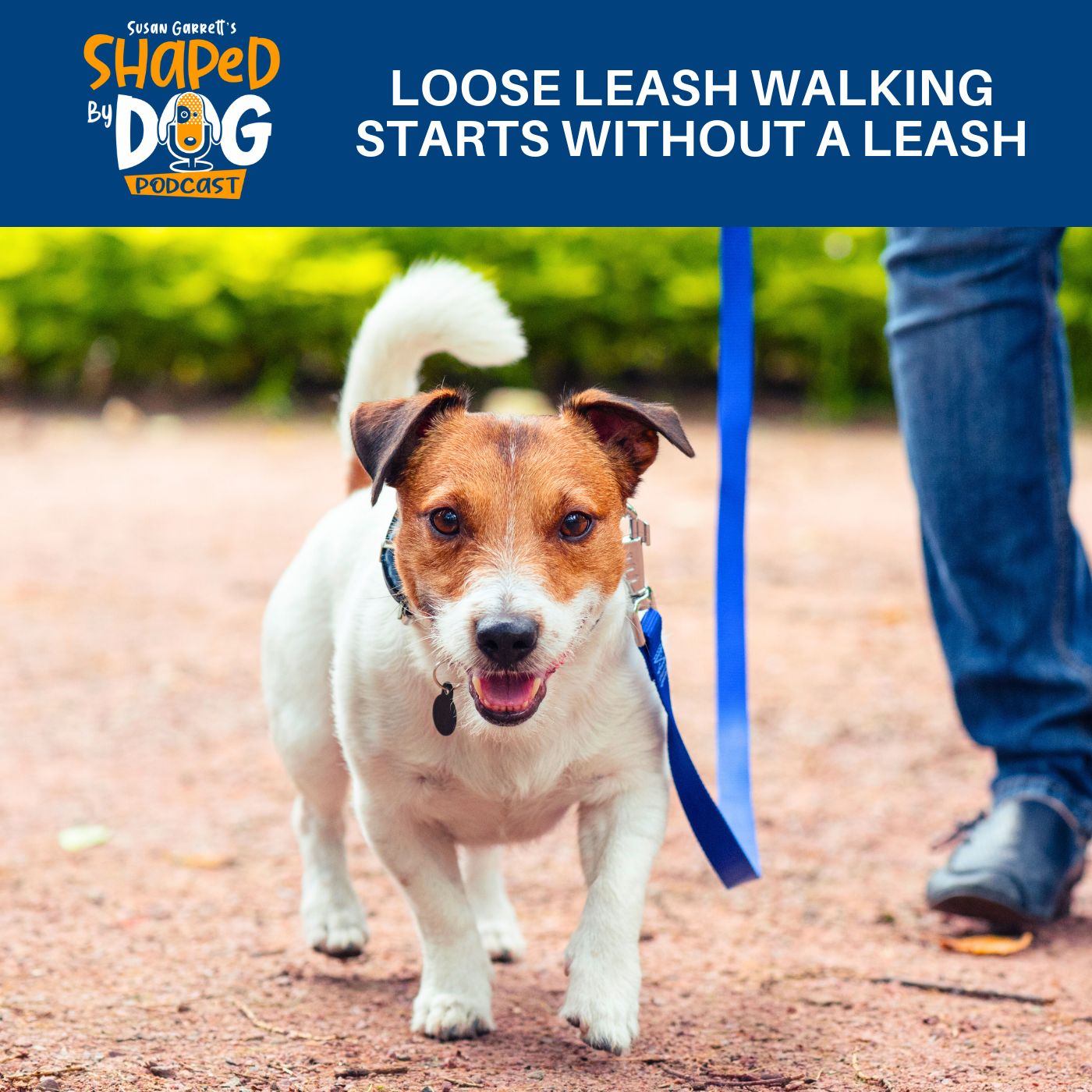
And this my friend is when loose leash walking goes terribly wrong. You get a new rescue dog, you get
a new puppy, you clip on the leash on their collar or on their harness and you want to take them for a
walk. When I teach my puppies, or rescue dogs, how to walk on a leash, I do it without a leash. Yes, I
said it, loose leash walking begins with no leash.
00:00:30
Hi, I am Susan Garret. This is Shaped by Dog, where dog training finally makes sense. I would like you
to think for a moment what kind of an emotional experience it is to take your dogs for a leashed walk.
Now you might have one dog, you might have more than one dog, when you go out for a walk with your
dog or dogs on leash, what is that experience like for you? What is that experience like for the dog?
For some people there is a lot of lunging, jumping up, maybe obsessing on something that they find in
the dirt. For others, it might be zigzagging across your path, spinning, and barking. Different behaviors,
same outcome.
00:01:11
Something that is meant to be exercise for both of you, potentially a bonding experience, and ideally an
ability to be out in nature and get yourself some Zen, some peace, some calm, but somewhere along the
way it didn't end up in that place. Zen, peace, and calm probably aren't three words that you are using.
If they are, well done you!
For many people it might be frustration rather than something that you look forward to. Understanding
that our dogs are doing the best they can with the education we've given them in the environment that
we've put them in. We get to see that the challenge isn't about the distraction. It's not about your dog's
emotional state or being overwhelmed or overexcited.
00:01:57
The challenge really is a mismatch of our expectations and our dogs’ experiences and education.
Because the leash walking experience fails miserably, at both ends of the leash, when the expectation
of the owner is severely outpacing the education of the dog.
When you think of leash walking, think of all that it entails, a dog walking calmly beside their human in a
straight line, not going out of position, going exactly where their human wants at the pace their human
wants them to go.
00:02:34
Can you think of a more unnatural behavior for a dog to do? And yet it's the most in demand behavior
for a dog to do and it fails more often than you would think. That's right, it fails. Most people do not have
success teaching their dog to walk nicely on a leash.
It's not you. It's many people. When we're asking our dogs to do something this unnatural, we owe it to
them to take the time and teach it extremely well. Unfortunately, that's not how it happens, and it's not
because you've done something wrong, it's just because of how leash walking is traditionally taught.
00:03:14
It's taught in reverse. We expect perfection of this dog at the end of our leash, and we haven't taken the
time to fully teach the understanding of how they can achieve that success. Once you see where leash
walking breaks down, you're never going to approach walking your dog on a leash the same again.
In episode 21 of Shaped by Dog, I outlined the 5C pyramid, which is a template of how I teach my dogs
anything and everything. It's a roadmap because behavior does not grow in isolation. We do not ask our
dogs to walk on a leash in a laboratory setting, we need real world results. And so, we need to have a
strategic path to get those results.
00:04:00
And that strategic path is growing understanding in layers, layers that lead up to real world walking the
dog. Anywhere you choose to. So, I would strongly encourage you to go back, and review Shaped by
Dog episode number 21 because those 5Cs are something that everybody can benefit by hearing yet
again. Let me quickly go through the bottom layer of our pyramid is that of Connection.
Connection is where all dog training begins. Connection is where your dog wants to work with you, and
it's not because they have to, it's because it makes sense to them. Connection is built through educational
games that the dog engages willingly.
00:04:41
It creates confidence. It gives the dog safety, and it puts you as the focus of everything you do together.
So, Connection is the beginning of all of our training. And layer two is Clarity, and that's where we
introduce the idea of a criterion which successfully outlines for the dog where success lies, what is within
the boundaries of you earning reinforcement.
And, because of the strategic way we arrange our antecedents, success isn't an accident. Success is
inevitable because early on in our training, we make the obvious choice for the dog the correct choice.
And make the incorrect choices almost impossible for the dog to choose. That is what brings clarity to
the dog so that we can go on and grow confidence.
00:05:32
Good dog training isn't about pointing out to the dog where they are wrong, where they are flawed, good
dog training is about building confidence in a dog, so they are driven to choose that which is correct. That
leads us to layer three.
All this Clarity inevitably leads to Confidence, our third layer of our pyramid. Let me be clear about this.
Confidence isn't automatically built simply by repeating a skill over and over. Confidence is built by a dog
demonstrating their understanding of the criterion of that skill by being able to perform it in new locations, anytime you ask.
00:06:10
The dog doesn't hesitate, and the dog lights up at the chance to show you how brilliant they are. That's
true confidence. Now it gets interesting. We're at layer four. We've got a confident dog who has a clarity
to know how to do the small behavior you've asked him to do. We're going to now add Challenge.
The challenge could be a distraction. The challenge could be how far away you are, what other enticing
things you've added to the environment. The key is challenge is introduced gradually and very
intentionally.
00:06:40
We can move back and forth between Confidence and Challenge based on the responses of the dog.
But here's where you may have a failure, but because the Clarity and Confidence, is so powerful in that
dog, you also have built in automatic resilience. They are 100% okay with making a mistake and jumping
right back in to show you how brilliant they can be in the face of that challenge.
You've got to remember; distractions never break behavior. They simply reflect back to you how effective
your training has been. And that leads us to the top of the pyramid, the top of the 5Cs, the top of that
pathway of learning for your dog, and that is Complexity. Complexity is where you will add known and
confident behaviors together to form real world understanding.
00:07:35
The dog now is at a stage where they're just showing off. The obvious choice is no longer the correct
choice. It's the incorrect choice. But the dog easily passes by the obvious choice because they know
what it is that you're looking for. They have the clarity. They have the confidence. They can be successful
in the midst of great complexity.
And that is what the real world is like for your dog and for mine. And this my friend, is where loose leash
walking goes terribly wrong because people want to jump in at the top of the pyramid. You get a new
rescue dog, you get a new puppy, you clip on the leash on their collar or on their harness, and you want
to take them for a walk.
00:08:17
Is there connection? Maybe, but unlikely. Is there clarity of your expectations? Not at all. Is there
confidence in what's going to happen and how to deal with any distractions? Not even a little bit. And
what has happened? We skip the pyramid and we blame the dog. And that's where people believe we
need to interject some form of correction to get the dog's attention, to get them to ignore distraction, to
create focus.
You do it right. Focus is a byproduct of all your training. You do it incorrectly in a way that doesn't make
sense to the dog, yes, you're going to have to teach a “Watch me”, a “Focus”, but it doesn't have to be
that way. I promise, it doesn't. Focus is a byproduct of that 5C pyramid. You get clarity, you get
confidence, you get a dog driven to show you how brilliant they can be, even in the complexity of the
real-world challenges.
00:09:21
Let's take all of this back to the sidewalk. We're asking a dog to do the unnatural in the midst of all these
real-world distractions ill-equipped because we've never given them the skills of what success looks like,
let alone how to deal with all of these distractions. And this is where the leash begins to become your
biggest problem because the dog leans heavily towards what it is that they want.
It could be a kid on a skateboard. It could be a special smell in the grass. It could be another dog walking
down the street, and you are leaning in the opposite way towards exactly what you want. Neither of you
are wrong. It's just that you're pulling in opposite direction because there's no shared plan.
We didn't get buy-in from the dog. We've never given the way how to be successful. And that's why when
I teach my puppies or rescue dogs how to walk on a leash, I do it without a leash. Yes, I said it. Loose
leash walking begins with no leash. [If you love what you’re learning, subscribing just means I get to keep
showing up for you every week.] I would say the leash isn't even a level three in the pyramid. It might be
something upwards of a level five.
00:10:40
We need that dog to be able to understand what we want before we add a distraction, and a leash for
sure is a distraction. But remember, clarity matters and this is all about to make perfect sense to you as
I walk you through what it looks like when I train my puppies or when I help my students train their puppies or rescue dogs, or even their 10-year-old dogs who've been at opposite ends of the leash for their entire life.
We can start today and make life better for you and your dog moving forward. You have to be patient
because as I said, it's one of the most unnatural things that we've ever asked a dog to do, and if we truly
want it to happen in a cooperative way, we have to be, not only patient, but enjoying the process as much
as we want our dogs to enjoy the process.
00:11:29
If you're a regular listener to this podcast, you have heard me refer to the area on either hip as the
Reinforcement Zone, the area that we want our dogs to understand ‘this is where your reinforcement will
happen.’ I want you to think of Reinforcement Zone less of a place, and more of a reflection of your
relationship in motion, because the keys to loose leash walking is your dog, number one, having a brilliant
understanding of what this area is.
They have to have this brilliant understanding without you luring them in here. They need to know what
Reinforcement Zone is, how they can get there on their own, how they can get there from all different
places in all different locations, and why it's important that they need to be there, and what Reinforcement Zone isn't.
00:12:19
So, you have to be clear about what that looks like for you. For me, when I give my dogs the “With me”,
which is a cue that we're going to be doing an intentional walk. Now the intentional walk may be just to
go by a distraction. The intentional walk may be to practice our intentional walking.
So it could be, depending on the stage and the age of my dog or puppy, it could be for three steps. It
could be for 30 minutes. But “With me” is a cue that tells my dogs, I need you on my hip. You don't have
to be looking up at me. That is a more ‘formal obedience’. You don't have to be, but you are going to be
on my hip walking with me.
00:13:03
This isn't a time for sniffing because it's a purposeful walk. We're going somewhere. This also isn't
something that is going to be the majority of my loose leash walking. So, in contrast to my purposeful
walking is something that I'll call ‘Wandering with’, meaning my dog is still on leash. They can sniff, they
can investigate, but it's ‘wandering with’, meaning it isn't an isolated vacation on your own.
You can sniff but keep up with the parade. You can't lag to the end of the leash where the leash gets
engaged. You can't forge a head where the leash gets engaged. You can ‘wander with.’ So, the majority
of the time when I'm walking with my dogs, it's wandering with.
00:13:45
And honestly if there's something my dogs are very intentional about sniffing. I don't have a problem,
provided I'm not like on a deadline, I’m stopping and letting them sniff. I think sniffing is one of the most
natural and reinforcing things for a dog to do. What better way for them to get it than with me in a
wandering with?
00:14:04
So, I have two separate cues, “With me”, purposeful you're at my side, you're walking with me, we're
engaged. ‘Wandering with’, I will cue ‘Sniffies’. Sniffies is, you can be around me if we're off leash, sniffy
is, they can wander in front of me, but they cannot get out of my eyesight. Purposeful walking versus
wandering with.
So, you have to decide what your criteria is. If you want both, like me, you can get both like me. I'm going
to outline for you what it is I do, to get that great understanding from my dogs. So, the program I'm
describing involves three props. Now, if you count cookies and a leash, and you know that's kind of
implied, the three props are a perch—.
00:14:49
Now, there's a video on my YouTube page called Perch work, Pivots and Spins, that gives you the stepby-step on how to shape your dogs, getting their front feet up on a perch, a perch needs to be elevated.
I would say depending on the size of the dog, I would have it at least the thickness of your dog's paws.
It can be a little bit more, but no more than double the thickness. So, if your dog's paw is two inches thick,
let's have your perch be two inches thick, give or take. Don't go crazy on this. The perch should be big
enough for your dog to get their front feet side by side comfortably.
00:15:22
So, if you've got a big Bulldog, it might need to be a little bit wider than if you have a little Chihuahua. So
comfortably with a little excess hanging over the edge. So, we have a perch. Next up is a plank. A plank
will be wide enough that your dog can sit on, long enough that they can stand on. You can just simply
take a piece of two by eight and cover it with a yoga mat.
If your dog is really big, you might have to add to the width of that. Or we'll leave a link in the show notes
where you can buy one of my favorite fitness planks from Galican who are, an agility supplier. But if you
live in North America, you'll find a link in the show notes that will give you a discount on getting one of
these Galican fitness planks.
00:16:07
So, we've got our perch, we've got our plank. The next thing you all have, you don't have to go out and
buying anything, your pants’ seam. Perch, plank, pants seam. Those are our three props to help really
build understanding of where Reinforcement Zone is. So, the perch is going to help the dog identify with
their front paws.
They can get up there. You can reinforce them. Now you put the perch beside you, maybe have it against
a wall, so the dog doesn't spin their butt out and you're just going to feed them and throw cookies behind
saying “search”, and they come up in position.
Then you can go to a plank because now we want them to be concerned with their back end and their
front end so that they come in, we need them walking straight. We don't want them backing up, so they're
looking at the cookies.
00:16:51
We want them walking straight in Reinforcement Zone. That's where the plank comes in. And finally, we
transition, your dog's forever target is your pants seam. So that is the target that tells them where
Reinforcement Zone is, once we fade away from the plank and the perch. So, we use the perch to start
our behavior initially then we go to the plank. So, we get our dogs thinking about straight.
00:17:17
Then we move it away from a wall so that the dog can do it without the help of the wall and stay on the
plank. Then, we have to get rid of the plank. We go to the pants seam. But here's where the fun begins,
because we have to eventually get moving. Loose leash walking isn't just about your dog driving into
Reinforcement Zone.
So, we bring back our perches, we put them into a square on the ground, and you walk from one perch,
and then you reinforce your dog on the perch. Then you walk in between the perch, you let them find
their Reinforcement Zone on your seam. You walk up to the next. You're walking in a square.
00:17:52
So, now we've created follow Reinforcement Zone in motion, which is the biggest part of loose leash
walking. So, the perch gives our dog our initial target. The plank gives our dog the body orientation. The
pants seam gives our dog that partnership in motion forever.
We want that pants seam, to be your dog's North Star long term, but we have to give them the tools for
them to be able to predict and be able to get into Reinforcement Zone on their own without help from
you. The movement of going from square to square is where everything clicks, where the dog shows
you, they understand Reinforcement Zone.
00:18:37
We've got to teach the dance steps before we can expect the dog to be able to give us the performance.
Now, if you're thinking, “Okay, but what do I do until my dog gets their performance? Do I never walk my
dog again?” Well, we've got you.
In the show notes, I'm gonna give you some links to some of our previous Shaped by Dog podcast
episodes, episode number 32, where I give you 20 exercises that you can do with your dog in the house.
Episode number 317 where I share 20 fitness exercises you can do with your dog. These are ways to
engage your dog's body, but walking your dog gives them way more than just exercises. We have to give
them enrichment so you can do enrichment activities, which I've outlined in podcast episode number 314
and 315.
00:19:25
You can also put your dog in the car and drive off to safe places like a Sniff Spot that you can rent, or if
you have a friend with a fenced in backyard. So, there is a lot of things you can do to avoid the struggle
of walking your dog on leash until you get a beautiful performance from your dog.
However, you can also just say “For now, I'm not gonna worry about my intentional, purposeful walking.
I'm just going to put a little bit more money in the bank for the wander with walk.” And that can be the
kind of walking you're doing until you build up to the place where you have both types of leash walks.
00:20:06
And if you're listening to this thinking, “Well, this all sounds great, but I'm unsure what to do next. How to
identify when my dog's ready to move on? What is the next step? When do I change from a perch to a
plank?”
All of that and more is what we've got in our J-Walking Program. It's a step-by-step program that teaches
you how I've taught my dogs loose leash walking, how my students have taught their dogs loose leash
walking. Now, this is a brand-new program. You'll find it on our website for an investment of $327.
00:20:40
However, you are a valued member of our podcast community, and because you do listen to Shaped by
Dog, I'd like to invite you to join for just 49 USD. J-Walking is a complete step-by-step educational
program that takes you right from the beginning, how to progress through this skill in the comfort of your
own home.
We have videos. We have downloadable PDFs that allow you to learn how to get your dog to move with
you through Reinforcement Zone long before you ever clip on a leash and take them for a walk. Because
the leash should be the last piece of this puzzle. Not the first piece.
00:21:22
If you would like to join our J-Walking Program, then send an email to my team at [email protected]
with the subject line ‘Connected Walking’. That will let my team know that you are serious about having
a better experience both for your dog and for yourself when you're out walking your dog on leash.
This isn't about managing your dog out on a walk. This is about educating your dog so that management
becomes unnecessary. Your dog doesn't need more corrections. Your dog needs more clarity. A
connected walk isn't a matter of luck. It's a matter of layers. Leash walking fails when expectations
outpace education. And J-Walking bridges that gap.
00:22:06
Again, if you're interested, drop my team an email at [email protected] with the subject line ‘Connected
Walking’. Thanks for joining me today. I know this is a longer podcast episode, but I didn't want to break
it up into two pieces. Until next time, stay curious, stay humble, and keep working to make life better at
both ends of the leash. I'll see you next time, right here on Shaped by Dog.