

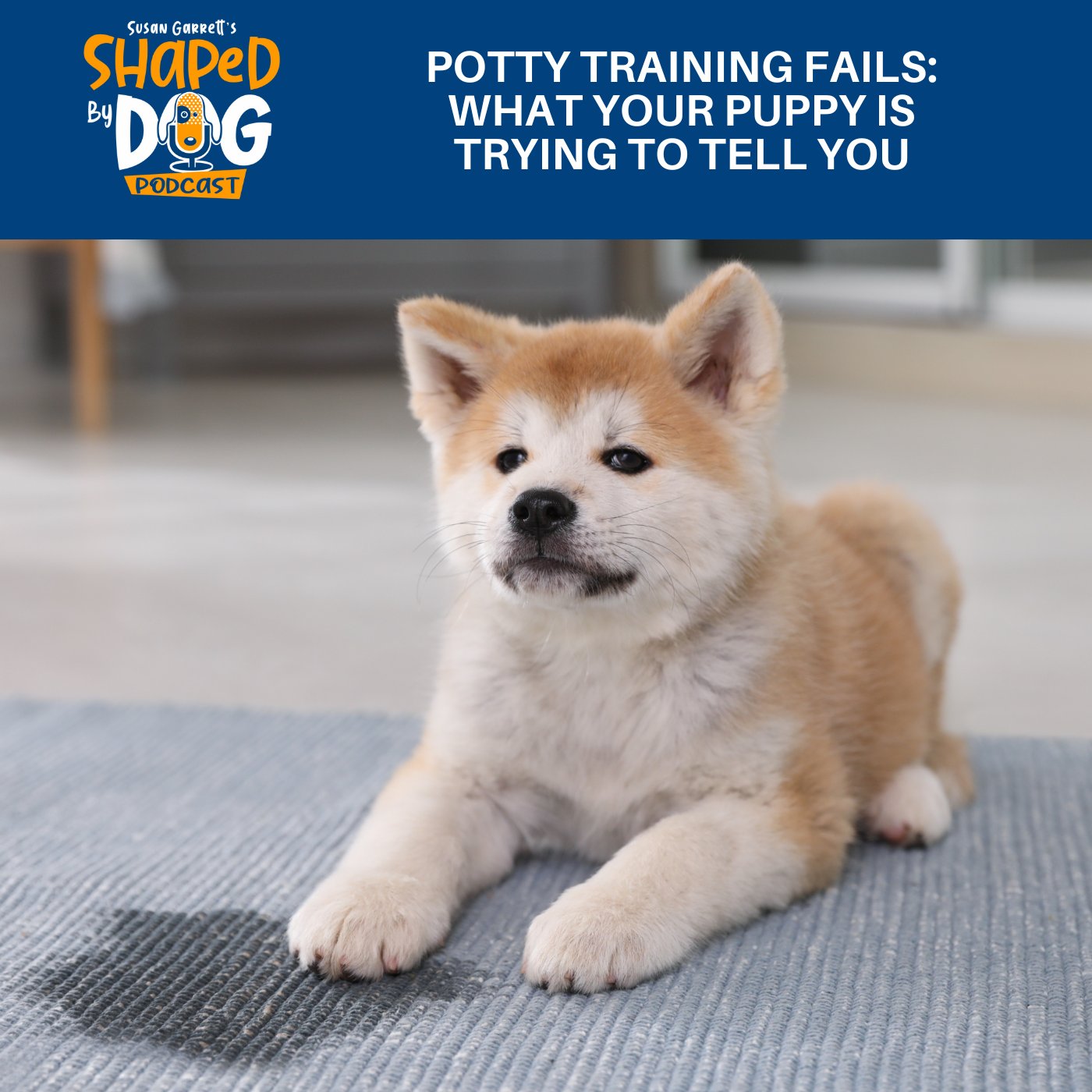
Our Shaped by Dog podcast is designed to be heard or viewed. If you are able, we encourage you to listen to the audio or watch the video, as each includes nuances of emotion and emphasis that might not come through on the written word. Transcripts are generated from the audio, then humans review with love and care, and then there's a double check by our dogs. If you are quoting in print, please check the audio first for full context. Thank you!
Speaker Key
SG Susan Garrett
Transcript
00:00:00
So, you think your five-month-old puppy is potty trained until a puddle on the kitchen floor tells you otherwise, and now you're frustrated, disappointed, and maybe a tad angry. Well, let's shelve all those emotions because today I'm gonna share with you why the potty training might not be going as well as you thought it was, what you can do about it, and how you can support yourself emotionally through this transition phase with your puppy.
00:00:40
Hi, I'm Susan Garrett. Welcome to Shaped by Dog. And the good news is that there's probably a dozen reasons why your puppy is still not potty-trained and not all of them lead back to you. So, in this episode, we're gonna build on episode number 48 where I explained my H.O.T. method of potty training your puppy and motivating your puppy to want to do their business outside in the backyard and not anywhere in the house.
So, if you haven't checked out that episode, that would be a brilliant place to start. The H.O.T. method is all about your habits, your powers of observations, and the timetable that you have your puppy on, but there's a lot of more good details in that episode.
00:01:27
This episode is about recalibrating your training and really doing a deep dive now that you know your puppy's true habits. So, the reasons I mentioned off the top why a puppy might still be having accidents in the house. The number one, which is not going to be any fault of your own, might be an underlying health issue.
So it could be that your puppy has picked up a bladder infection. There could be any number of reasons. So always best to get your puppy to a veterinarian if the puppy is still having accidents in the house and you can't quite figure out why. A great way to decide if your puppy potentially does have a medical condition is answer this question, has your puppy had an accident in their crate?
00:02:07
Or has your puppy had an accident in their pen area? Episode number 48, it referred to both of those areas. Or if you're a person who confines your puppy in a small room, has your puppy had an accident in that small room? If the answer is no, they know that’s their living area and they never had an accident in there, then potentially your problem is one of my other suggestions.
If they are having accidents in there and you've done everything I've suggested making that area a little bit smaller for a little while, and they continue to have accidents in there, then definitely you should check out and take them to a veterinarian and make sure that there isn't a problem.
00:02:42
However, if your puppy never has an accident in their home area or their little pen area, but they continually have accidents in your house, that tells me it's very likely any one of the next number of reasons. That tells me it's very likely any one of the next number of reasons. Another like lesser common reason, but also quite possible is weather related.
00:03:01
That some puppies have issues with different textures on their feet, so they might not like cold weather if you live in a cold climate area. Or if you live in an extreme hot climate area, it could be they don't like the hot pavement on under their feet. Or a very common is, especially with little dogs, they don't like wet grass.
All of those things, you can counter condition. You can counter condition the puppy so that they love the feeling of snow. They love the feeling of wet grass. That is just going to be a little project on your own. If you'd like some help with that, leave a comment and I will share with you how you can help your puppy to love walking on wet grass.
00:03:40
Now, all of the rest of the reasons I'm afraid possibly may lead back to you. The first off is I find people have unrealistic expectations of their puppies. They think that their four-month-old puppy should never have an accident in the house. And the truth is they're four-month-old puppies, so they might still have the odd accident in the house.
You need to be a data collector of every puddle and every pile that happens in your home, where it happens and when it happens, what has happened before or after. So, time of day is important. The last time they ate, the last time they played, the last time they slept. When are these happening?
00:04:24
So, for some puppies, it could be that they go outside, and they come back in, and they immediately have an accident. So possibly you might have a double pee-er that they need a chance to go twice before you bring them back in the house. I like to give puppies three minutes. I like to help my puppies understand that I would like them to eliminate, relieve themselves as soon as they go outside.
So, three minutes is the top level. We talked more about that in episode number 48. So, tamper your expectations. It's not going to be perfect, but eventually we will get there. Number two, super common reason, it’s related to the number three reason.
00:05:02
Number two is poor supervision. So, in episode number 48, I really recommended people use a crate and teach your dog, your puppy, to love the crate. Love, love, love that. It's the best place ever. And I also suggested that you use a pen, a small pen. Now saying, “Well, my puppy's four months old. I'm giving her a lot more freedom outside of that pen.”
That's great. But you can't then say you have the run of the house for the next few hours. “I've got work to do on my computer.” They're still a baby. They still are going to need to relieve themself. So, the first little while, it's like a transition. From giving them more time out of their pen area means that you are going to be supervising what they're doing.
00:05:51
You don't have to like, follow them around. You're gonna be like observing from a distance, but you are not going to get busy cooking supper. Or doing something when you're not going to notice what they're doing. Related to poor supervision is too much freedom. So, you live in a 4,000 square foot home. That doesn't mean the puppy needs to be able to wander 4,000 square feet of area. So, if they graduated from their pen, you might like, take them to a small room where you can set your computer down and work in the small room, see if they have any accidents in this small room.
00:06:23
And if after two weeks of being in the small room, they haven't had any accidents, then you can grow a little bit more of their freedom as they get older. It's a transition period. But your supervision has got to happen every time you expand their living area.
So, when you go from the pen to that small room that you're gonna bring your computer or whatever it is, your coffee to sit and read a book, you're gonna be kind of supervising because you haven't had any accidents. You went from pen full supervision for a week, didn't have an accident. And then we went to going to a bigger room and you're not gonna be as intense with your supervision.
00:07:02
Number five reason, and this is a really very likely reason for many of you, is you've been managing that puppy's behavior and you haven't really trained the puppy's behavior. What I mean by that is maybe you're taking that puppy out like clockwork after they wake up, first thing in the morning, after every meal, after every place at all the things I mentioned at episode number 48.
But you've never picked up on a puppy's tell because you're taking them outside every 30 minutes to an hour maybe, and so they just get to relieve themselves and they learn that ‘I get to go outside,’ so they never learn how to communicate with you, how to tell you, “I need to go out now.”
00:07:46
And so how does an animal communicate that with you? There's a number of ways. Tater Salad decided scratching at the window right near the front door is how he's going to tell us that “I would like to go outside.” Now, personally, I don't like that, but he's never touched the wood, so I am okay with it. I would never recommend you encourage a dog to do that.
Swagger is quite vocal. He'll go stand at the front door and he'll just bark, and he will continue to bark until somebody comes and lets him out. I think that's perfectly acceptable. Now, some dogs’ communication is far more subtle, like whining. My dog This!y, her communication is very subtle in that she will come and lick you and you're going, “Oh, do you love me?” “Oh wait, do you have to go out?”
00:08:36
Momentum is even more subtle than that. She'll just stare at you. Sometimes she'll run away and come back and stare. So, what is your dog's communication? And do you need to amplify that communication? For example, if I've locked myself in my office, Momentum is not able to stare at me. So, she's not able to tell me that she has to go out.
So that really isn't an effective communication. You know, I would prefer that we use something else. So, you can teach your dog to bark on cue. That's an easy one. You can then ask the dog to speak and then say, “Do you want to go outside?”
00:09:13
Eventually the dog will pair. Speaking means we go outside. So, you can do that. You can, what's very fashionable these days is buttons. Create a button that says outside and teach the dog to touch that button.
Our free YouTube video on targets would be a great thing for you to teach your dog to hit one of those buttons. Some people have success with putting a string of bells by their front door and teaching the dog to either paw the bells or nose the bells. Then you can tell they need to go outside.
00:09:44
But if the dog doesn't have a clear communication, if you've been managing all of the time and you haven't learned what your dog's tell is. Then that's likely why they're having accidents because they might be, like it might be something as subtle as pinning their ears or getting wide eyes and panting, heavy panting. Like there's a lot of different ways that the dog will try to communicate with you that those are the times when you're going to say, “Do you have to go outside?” Outside and get up and go outside.
Number six reason, you might have an inconsistent routine. So, if the puppy doesn't know that there is an opportunity to go outside somewhere else, then they may just go somewhere in your house. Because they don't know when the next opportunity to go outside is, and they don't know how to tell you that they need to go out right now.
00:10:34
So H.O.T. Habit is our first H and that's really, you want to create a habit where after five minutes after I fed you, and as that puppy gets older, it might be 10 minutes, 15 minutes, 30 minutes, somewhere as an adult dog, my dogs do have to go outside, probably within an hour of eating, and sometimes it's less than that.
But with puppies it could be almost like immediately, especially if it's a wee puppy. Reason number seven, why your puppy might still be having accidents in the house is you haven't really done a great job of cleaning up a previous puppy accident. And so, I love to use enzymatic cleaners where the smell and any evidence, any trace is easier to eliminate from the environment.
00:11:17
And if you go to your record keeping, you will notice, ‘Oh, they're having an accident in the same area.’ Now some puppies love to do their business on carpet. So, if you just not give your dog access to any carpeted areas, they would prefer grass to the slippery tile floors. So, they may learn quicker to go outside if you don't give them access to carpets.
Also, cleaning up on a slippery surface is much easier than cleaning up on your carpet. Some puppies, depending on the time and their growth, may just relapse. Maybe teething, create some extra stress to their body. Maybe they had a growth spurt, or hormones are contributing—especially in males. They might start lifting their leg in your house, so you might have to dial back the freedom you've given those puppies.
00:12:08
So, the age and the stage of development will definitely have an impact on the puppy's potty behavior. Reason number 10 would be if your frustration builds to an emotional outburst on your behalf, maybe you are scolding the puppy, maybe you're like, “Whoa, you're such a disappointment. Why can't you get this?”
The puppy may have some anxiety around their pottying behavior, and they may start hiding and going places and eliminating in the house. We don't want that, and I'm just gonna put this final reason out there as a possibility.
Some puppies, when they get excited, they will what we call submissively eliminate, in that they just have a little tinkle. They can't control that. So, I have a separate episode on what you can do if you have a puppy that is an excited greet pee-er when they greet people. So that is nothing to do with behavior.
00:13:00
At the end of the day, if your puppy is able to control their bladder but they're still having accidents in the house, you've got to find where the reinforcement is coming for that puppy, because reinforcement builds behavior. And the most obvious reinforcement for the puppy is “I feel better when I pee. I feel better when I've got that load out of my system. So, it's very reinforcing to pee or poop in the house.”
“I get it. When you take me outside you want me to pee and poop outside, but when you don't take me outside, you want me to just find a spot in the house. I get it. I got it.” Alright so, we need to communicate differently. So, what are we going to do now?
00:13:36
First thing I would do, I would visit episode number 158, which is on positive interrupters. It's a way that we're going to interrupt our puppy’s behavior to redirect them to another behavior. And I would recommend using something like “ding, ding, ding.” And that would be getting that puppy's attention. They'll run to you because that sound is associated with something good as you'll find out in episode number 158.
And so, when you see the tell, like you know your puppy circles before they're going to eliminate, you are gonna say, “ding, ding, ding.” And run and grab that puppy and say “outside.” Take them outside, hook the leash on, and let them eliminate outside. Your goal is for them never to be an accident that you find by accident.
00:14:21
I'm much happier when I see my puppy about to squat to do their business. I am unhappy when I find a puddle because that means, “Susan, you let that puppy down. That puppy had to eliminate and you weren't paying attention, so they just did it.”
So, I am way happier when the puppy gives me a subtle tell, and I will work to build that to a bigger tell. And that positive interrupter is part of the process. Alright so, we've got a reset. You know now you've got to dial up your powers of observation and maybe you've got to help that puppy communicate better with you.
00:15:03
So, I would like you to take a week to intensify your supervision of that puppy, to decrease the amount of freedom that the puppy has in your house. So, for you to be able to pick up on those tells early, use the positive interrupter, not just for potties, but for maybe you're gonna take the puppy for a walk, you can say, “ding, ding, ding.”
They might be chewing on a bone, and then they learn to come to you, and you take them outside. It could be that they're playing too rough with another puppy or another dog in the house, “ding, ding, ding.” You want to interrupt that and redirect them maybe to a bed so they can earn cookies for hanging out in the bed.
00:15:38
Positive interrupter isn't just for potty training. You'll use it for a lot of things. But it is a tool that will help with that training. Now you've gone a week, and your puppy has not had an accident. You need to build in a reinforcement for you. So, what is that gonna be? Get the family in on it. If we can get a full week of zero accidents in the house, we are going to go out for supper, we are going to celebrate by buying the puppy a new toy.
00:16:06
Whatever it is, have a reinforcement for you and for the family to celebrate one week of no potty accidents. And then what you're going to do is you're gonna take a normal time when you would just take that puppy outside. Maybe it's after they've eaten, maybe it's first thing in the morning, and you know that that puppy has to go.
And you're just going to put them down in the kitchen. Near a door that takes them to their potty area. The moment you see them go to squat, use your positive interrupter, “ding, ding, ding”, “outside, outside”, and take them outside. And then you're gonna do another week of making sure they don't have any accidents.
00:16:48
You want to intertwine management, so you don't have accidents with forcing that puppy to communicate with you that they have to go outside and that is going to be less putting them down and watching them till they give you a tell that they're going to potty in your house. Much better than them hiding somewhere to potty.
So, the final thing I'm gonna ask of you, and you may not need this, but some of you might need an emotional reset. You might need to recognize that any failure a puppy has is just feedback. It's just feedback to say ‘What? Is it too much freedom’? Is it, ‘I don't know how to communicate that I need to go out with you’? Is it ‘you're not observing me enough’? Is it a medical condition? Is it, ‘it's wet outside’? What is it?
00:17:32
Record keeping when you have those accidents, where, on what surface, what time, what activities happened before it. That's going to help you know what your puppy needs. But in the meantime, I need you to look at any failure as unemotionally as you can. It's just feedback. It's just feedback.
“I'll data collect that, and I'll move on.” You need to understand potty training above all else is all about progress, not perfection. Because they're dogs and maybe they'll never be 100% perfect. They might, when they get older, have another accident in their house. That's got to be okay.
00:18:09
You're gonna rebuild that trust with your dog so that they know they can communicate clearly with you, that they need to go out and you're gonna remind yourself the goal is, relationship number one, we will get to where we're going to.
I don't need to control everything you do. I just need us to work together with this. I'll create my Zen self, and I'll celebrate every 24-hour period that we have with no accidents in the house.
00:18:39
I hope this makes sense for each of you. And if you do have a puppy, you might be experiencing puppy nipping, so you might want to check in on episode number 234, all about how to stop your puppy from biting. I'll see you next time right here on Shaped by Dog.